
In summary
- Haute-Savoie is one of the best areas to start: many resorts offer marked routes where you ascend along the edge of the slope and descend through the ski area.
- You need to be comfortable skiing on blue runs at least, and be equipped with touring skis, climbing skins, and the safety trio avalanche beacon, shovel, and probe.
- For the first outings outside the resorts, professional guidance is essential: mountain guide, alpine club, or guided trip.
- The best period to start is from January to March, when snow coverage is stable and the days are longer.
Ski touring, in a few words
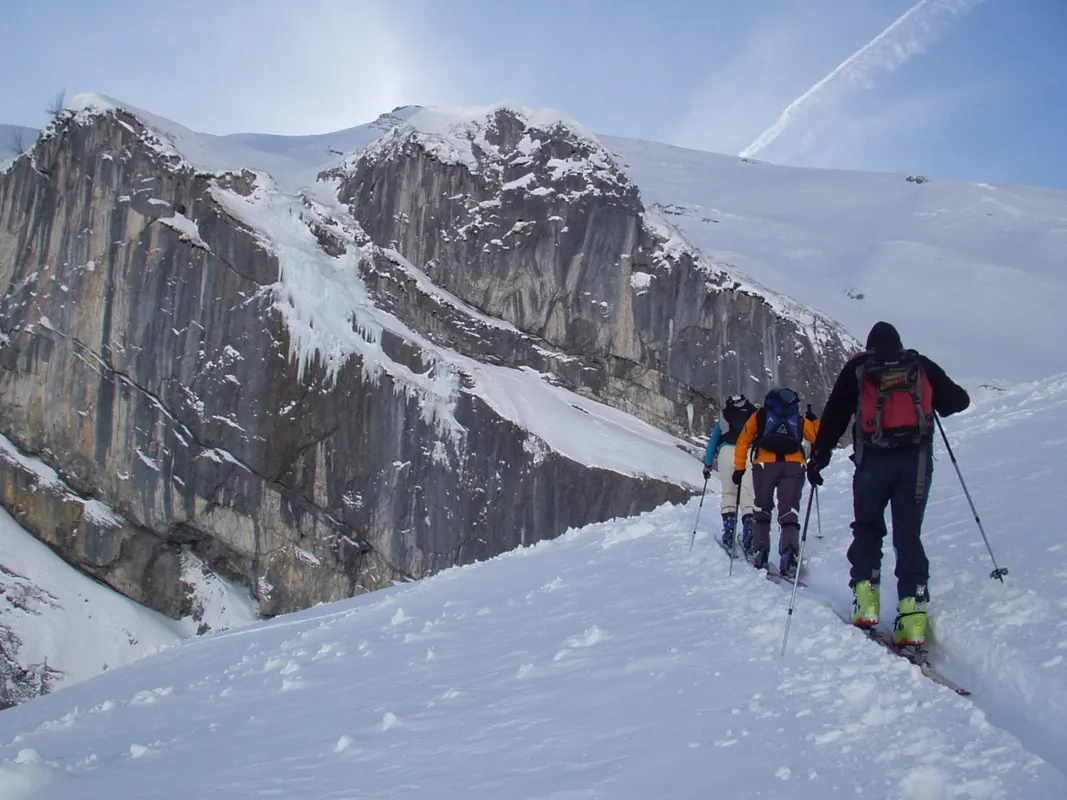
The principle is simple. On the way up, you attach bands of fabric under your skis, the climbing skins, which slide forward but grip backward. The bindings free the heel, allowing you to walk. At the summit, you remove the skins, lock the heel, and ski down like alpine skiing.
This apparent simplicity hides a comprehensive activity. Ski touring requires varied physical and technical skills, both uphill and downhill. You need endurance to cover several hundred meters of elevation gain, good skiing technique to descend on ungroomed snow, and above all knowledge of the mountain environment once you leave secured areas.
Prerequisites: are you ready to start?
Before putting on skins, ask yourself two simple questions.
Are you comfortable skiing on blue runs? This is truly the minimum. If not, it is better to first progress in alpine skiing, because ski touring is not just about going up: you have to be able to ski down well afterwards.
Are you comfortable in all snow conditions? For routes within resorts, where the descent is on piste, it is not essential. But as soon as you consider outings in the wild, being able to ski in powder, crusty, or transformed snow becomes necessary.
Physically, there is no need to be an athlete. Regular sports practice, such as running, cycling, or summer hiking, is enough to approach the first beginner routes calmly. The secret is to start slowly: in ski touring, the right pace is the one that allows you to talk while ascending.
With whom to start?
This is probably the most important question. Ski touring allows access to isolated and wild areas, but this environment is not secured like a ski area. You must therefore know how to assess the weather, snow conditions, and avalanche risk yourself, and this is something you learn.
With a mountain guide
This is the safest solution for your first outings outside resorts. Companies and mountain guide offices in Haute-Savoie (Chamonix, Saint-Gervais, Annecy, Les Contamines…) offer introductory outings, either for a day or several days. The guide chooses the route according to conditions, teaches technique, and passes on the basics of mountain safety. A small group outing allows sharing the cost.
With a ski instructor
Some ski schools offer ski touring introductions, often on marked routes within the resort. It is a good way to discover climbing technique in a reassuring setting.
With an alpine club
Local sections of the French Alpine Club, notably in Annecy, Chamonix, or the Chablais, organize guided outings by trained volunteers, safety training sessions, and beginner initiation cycles. It is an economical and friendly solution, which also allows meeting outing partners. However, you must join the club and register at the start of the season.
Within a guided stay
Another possibility: spend a few days in a group with a certified guide. Several agencies and organizations offer ski touring stays designed for beginners, over a weekend or several days, often including a night in a refuge. This option combines technical learning, safety, and accommodation, allowing rapid progress by doing several outings in a row.
With friends? Not just yet
Going out with experienced friends might seem like a good idea. But practicing without professional guidance requires real skills in snow science and navigation, and not all experienced skiers are good teachers. Reserve this option for marked routes within resorts, or wait until you have completed some training.
Comparison: which option to start with?
| Option | For whom? | Advantages | Limits |
|---|---|---|---|
| Marked route in a resort, independently | Good piste skiers, to test | Accessible, economical, piste descent | No guided learning, does not prepare for off-piste |
| Introduction with an instructor | Complete beginners | Reassuring setting, technical learning | Often stays within the resort boundaries |
| Outing with a mountain guide | Beginners wanting to discover real mountains | Maximum safety, route adapted to conditions | Higher cost, to share within a group |
| Alpine club | Regular practitioners, long term | Economical, comprehensive training, group spirit | Membership and fixed schedule required |
| Guided stay of several days | Those who want to progress quickly | Immersion, rapid progress, logistics included | Commitment for several days |
How to start: the equipment
Basic equipment
- Ski touring skis: lighter than alpine skis, they facilitate the ascent. To start, a versatile model with moderate width at the waist is quite sufficient.
- Bindings: insert bindings (called “pin bindings”) or frame bindings. They must allow freeing the heel to climb and locking it to descend.
- Boots: they have a “walking” mode that frees the cuff. This is the most important piece for comfort, and it deserves a proper fitting in a store.
- Climbing skins: cut to ski width, they stick for the ascent and are removed at the summit.
- Crampons: these small blades attach under the ski and improve grip on hard or icy snow.
- Poles: preferably adjustable, to lengthen on the ascent and shorten on the descent.
Safety equipment
This trio is essential as soon as you leave the secured ski area:
- Avalanche beacon (DVA, or ARVA): a transmitter-receiver carried on the body that allows locating buried persons.
- Shovel: to dig out a victim.
- Probe: to precisely locate a person under the snow.
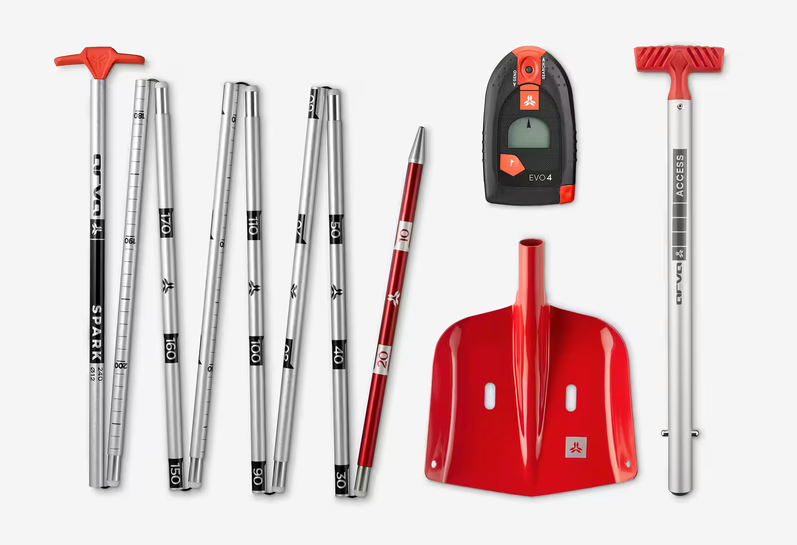
Having this equipment is useless if you do not know how to use it. Avalanche beacon search exercises must be repeated regularly. Many resorts also have “DVA parks” for training.
Rent or buy?
For your first outings, renting is essential. It allows testing the activity without investing, finding the right type of equipment for you, and getting advice from a professional. Most sports shops in Haute-Savoie resorts rent complete packs: skis, skins, boots, and often the DVA-shovel-probe kit. Buying can come later, once your practice is confirmed.
Clothing: the three-layer system
In ski touring, you get very warm going uphill and cold at the top. Hence the importance of the multilayer system: a breathable technical base layer, a warm intermediate layer (fleece or light down jacket), and a waterproof windproof jacket. Also plan for two pairs of gloves (thin for the climb, warm for the descent), a hat, sunglasses, sunscreen, and a 25-30 liter backpack to carry everything.
How to start: technique
The climbing step
Climbing does not consist in walking, but in sliding the ski forward without lifting it. Steps are short, weight is evenly on both skis, and the rhythm is steady. A classic beginner mistake is to start too fast. It is better to climb slowly but without stopping than to get out of breath in ten minutes.
The climbing risers
The bindings have risers that lift the heel. They make climbing more comfortable on steep slopes. Use them depending on the incline, but not excessively on flat terrain.
The turn
This is the hallmark technical move of ski touring: the on-the-spot half-turn that allows changing direction on a slope too steep to go straight up. It requires some practice and good balance. It is typically what you learn during a guided outing, on a gentle slope, before applying it in real situations.
The transition
Removing the skins, locking the bindings, switching the boots to ski mode, putting everything away in the pack: this manipulation at the summit is called the transition. At first, it takes time. With practice, it becomes a routine of a few minutes.
Where to start in Haute-Savoie?
Marked routes in resorts: the ideal starting point
This is the major development of recent years. In response to enthusiasm, Haute-Savoie resorts have created dedicated ascent routes. They are generally marked along the edge of the slope or in the forest, and the descent is made on the ski area’s pistes.
There are over twenty marked routes in the department, with beginner routes (less than 600 m elevation gain) and advanced ones (600 to 900 m) spread across about ten resorts, including Avoriaz, La Clusaz, Chamonix, Combloux, Flaine, Le Sambuy, Le Grand-Bornand, Les Carroz, Les Gets, Praz-de-Lys-Sommand, and Saint-Gervais. The Mont-Blanc area has even published a guide listing 29 marked routes facing Mont-Blanc.
These routes have a big advantage: they allow focusing on climbing technique without managing navigation, and descending on familiar terrain.
Be cautious with a common misconception. A marked route is not a ski piste. These routes are taken under the sole responsibility of the users and are neither controlled nor secured. Some resorts also require carrying an avalanche beacon, shovel, and probe. Always check with the tourist office or piste service before setting out: access times, current conditions, possible fees.
The Aravis: beginners’ playground
Between Annecy and Mont-Blanc, the Aravis massif is often recommended for beginners. Le Grand-Bornand has positioned itself with five routes for all levels. At La Clusaz, the ascent to the summit of the Beauregard plateau, at 1,690 m, is particularly suitable for beginners as the descent is on pistes. The Étale route, more technical, already requires knowing how to do turns. Manigod also offers a small route suitable for families wanting to try the activity.
The Mont-Blanc area
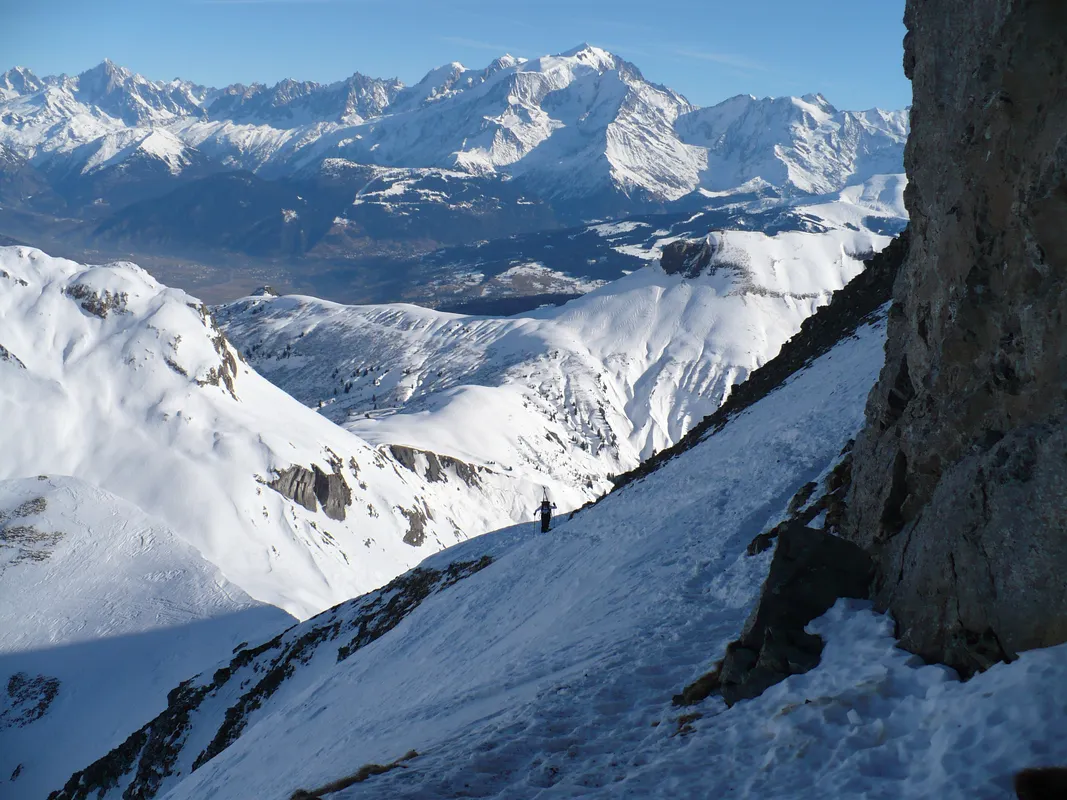
Chamonix, Saint-Gervais, Les Houches, Combloux, Megève, Les Contamines… The Mont-Blanc area gathers a large number of marked routes, with the Mont-Blanc massif as a backdrop. It is also the birthplace of alpinism, where guide companies offer introductions all winter long.
The Grand Massif and Haut-Giffre
Around Flaine, Les Carroz, and Samoëns, the Grand Massif offers varied terrain. At Les Carroz, three routes are marked for enthusiasts and those wanting to discover the activity. The tourist office advises beginners to rent their equipment from a professional and take their first guided outing. Further away, Haut-Giffre, around Sixt-Fer-à-Cheval, remains a wilder sector to discover once the basics are acquired.
The Chablais and the Prealps
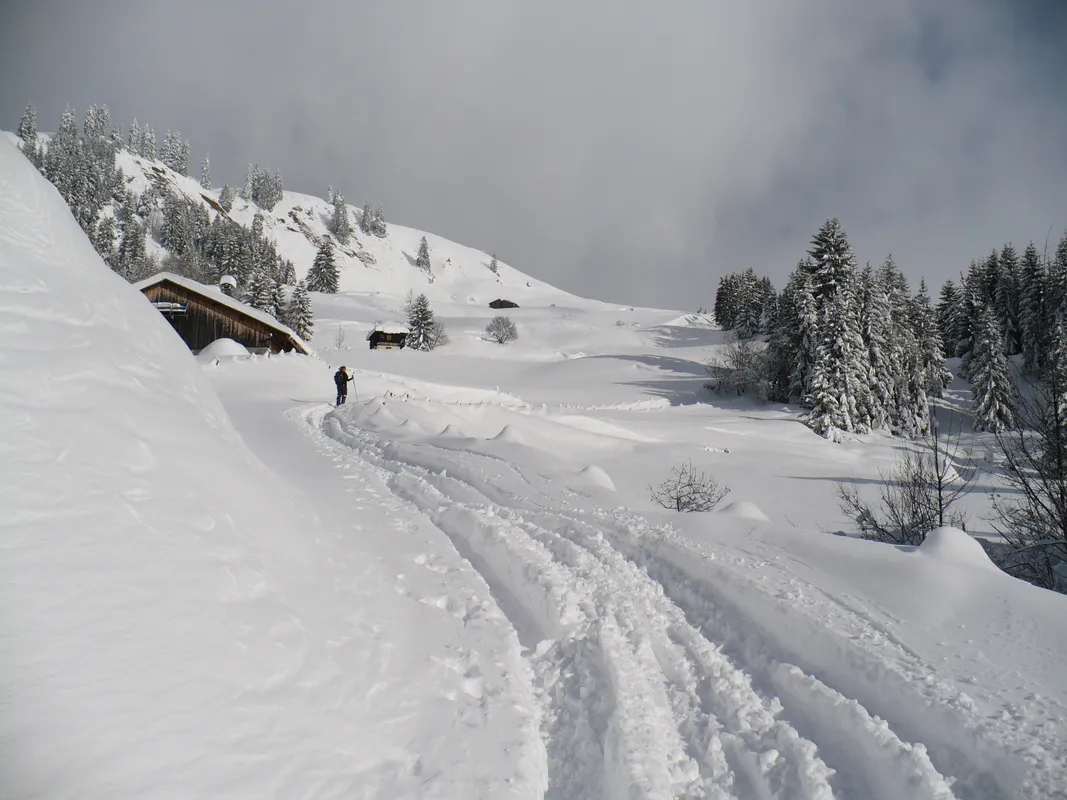
Around Avoriaz, Les Gets, Morzine, or Praz-de-Lys-Sommand, the Chablais offers softer, often wooded terrain. More broadly, the Haute-Savoie Prealps, between 1,000 and 2,500 m, count many alpine huts and unmanaged refuges, perfect for medium mountain outings once the basics are acquired and always considering snow safety conditions.
Safety, a continuous learning process
Check the avalanche bulletin
Before any off-piste outing, the first reflex is to check the avalanche risk forecast bulletin (BERA) published by Météo-France for each massif. It assesses the risk on a scale from 1 to 5 and describes the most exposed slopes and altitudes. Learning to read it is one of the first steps of training.
Get training
Beyond the first guided outings, there are mountain safety training courses in winter: avalanche beacon search introduction days, snow science courses, training cycles in clubs. They allow progressively gaining autonomy.
Some common sense rules
- Never go off marked routes alone.
- Always inform someone of your itinerary and expected return time.
- Start early in the morning, especially in spring when snow warms quickly.
- Know when to turn back: the mountain will always be there tomorrow.
- Respect wildlife quiet zones, particularly fragile in winter.
When to start?
The ski touring season generally runs from December to April, depending on snow coverage. To start, January to March is often the most favorable period: snow is well settled, marked routes are open, and the days lengthen. Spring, with transformed snow and mild days, is very pleasant but requires good time management due to snow warming during the day.
And after?
Once the basics are acquired, possibilities are endless in Haute-Savoie: first outings in the wild with a guide, nights in refuges, spring tours, and maybe one day the big traverses of the Mont-Blanc massif. Many practitioners also find in ski touring a way to maintain their fitness all winter long, going up early in the morning or at the end of the day on their resort’s routes.
The day you decide to buy your own gear, consider secondhand: every autumn, the Haute-Savoie ski sales offer touring skis, boots, and skins at reduced prices, often with expert advice from ski club volunteers.
FAQ – Starting ski touring in Haute-Savoie
Do you need to know how to ski to do ski touring?
Yes. At minimum, you need to be comfortable on blue runs in alpine skiing, as descent is done skis on feet.
Where to start ski touring in Haute-Savoie?
On marked routes in resorts like Le Grand-Bornand, La Clusaz, Les Carroz, Flaine, Les Gets, Avoriaz, Chamonix, or Saint-Gervais. You ascend on a dedicated track and descend on the pistes.
Are marked routes safe?
No. They are neither controlled nor secured like ski pistes and are used under the responsibility of the users. Check conditions before setting out.
What equipment do I need to start?
Touring skis with appropriate bindings, boots with walk mode, climbing skins, and poles. To leave ski areas, you also need an avalanche beacon, shovel, and probe. Renting is recommended to start.
Is it necessary to have a guide to start?
For first outings outside resorts, yes. A mountain guide, instructor, alpine club, or guided stay allows learning technique and safety rules.
What is the best period to start?
From January to March, when snow coverage is stable and marked routes are open.