
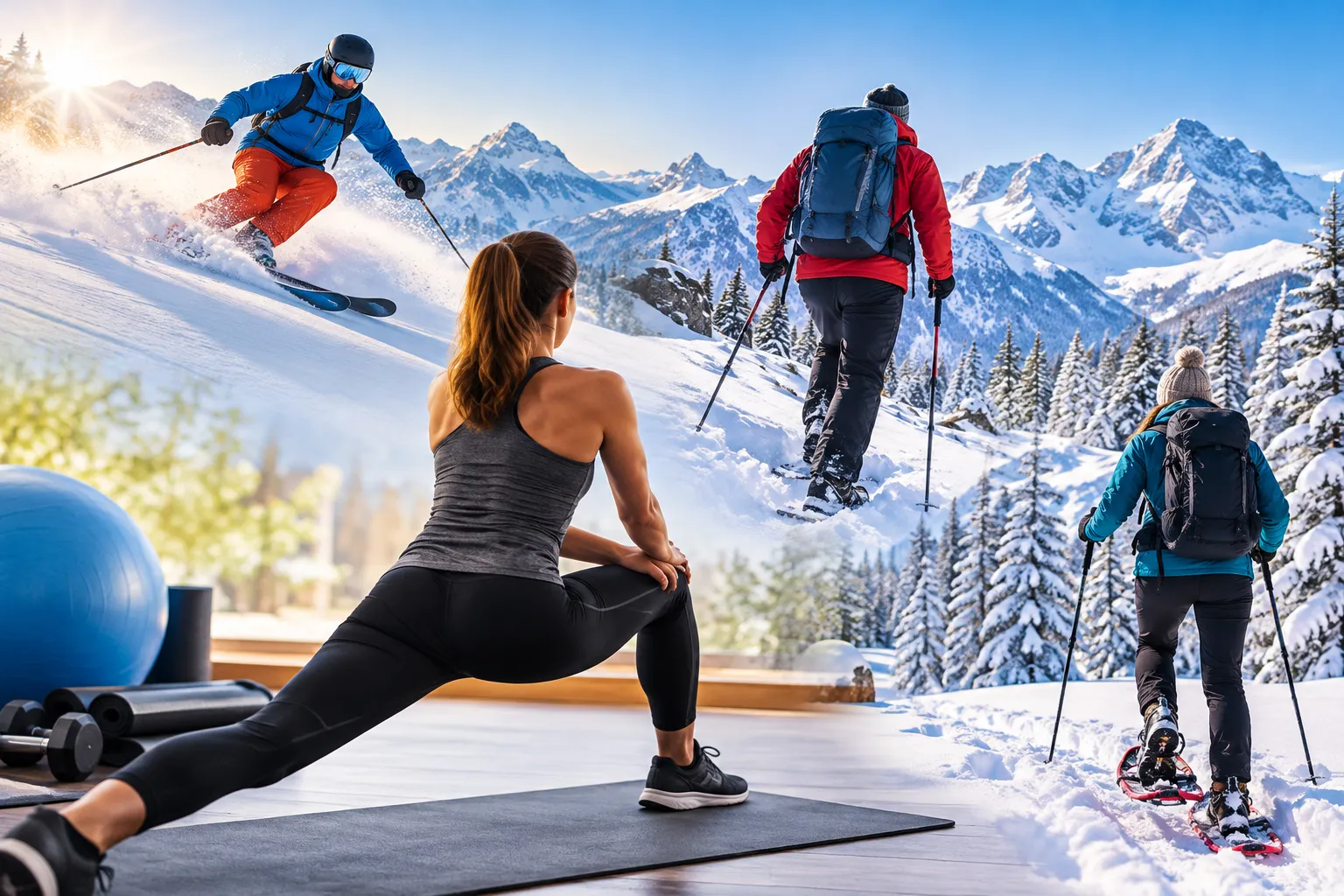
In brief
- When should you start? Ideally 6 to 8 weeks before departure, or even 2 to 3 months if you are not very active.
- How many sessions? 2 to 3 sessions of 30 to 45 minutes per week are enough, as long as you are consistent.
- What should you work on? Your legs (thighs, glutes, hamstrings), core strength, balance and cardio endurance.
- Why? The knee is the most commonly injured area in skiing, and fatigue during the first few days significantly increases the risk of falling.
- Depending on the activity: downhill skiing requires strength and quick reactions, while ski touring and snowshoeing mainly call for endurance and strong legs for both uphill and downhill sections.
Every winter, thousands of holidaymakers go from their desk straight to the slopes without any transition. The result: burning legs by the second day, a stiff back, and sometimes an injury that ruins the trip. Whether you are heading off to ski, hike or snowshoe in Haute-Savoie, a few weeks of physical preparation can make all the difference. Here is advice from recognized professionals, a simple programme you can do at home, and practical examples for different fitness levels.
Why prepare your body before a mountain getaway?
Knees: the most common victims of winter sports
According to data from the Médecins de Montagne network, cited by Dr Jean-Marie Fayard, an orthopedic surgeon and current president of the medical commission of the French Ski Federation, around 150,000 winter sports enthusiasts are injured in France each year, nearly 80% of them skiers. A tear of the anterior cruciate ligament in the knee is the most common injury, accounting for around 18% of injuries. Beginners and women are most at risk.
The mechanism is almost always the same, explain Dr Fayard and Bernard Bonthoux, the FFS’s federal physiotherapist: the skier loses control of their outside ski, the inside ski catches in the snow, and the knee undergoes a sudden twist before the muscles have time to react. This is why strong muscles and good balance reflexes are important.
The third-day trap
Physiotherapists at the Espace Santé des 3 Vallées in Savoie observe that many injuries occur around the third day of a trip, when soreness and fatigue set in. They also cite other well-known risk factors on holiday: lack of sleep, alcohol and unbalanced meals. A well-prepared body copes better with consecutive days of activity and stays alert for longer.
Skiing, hiking, snowshoeing: different kinds of exertion
- Downhill skiing: short, intense bursts of effort, a lot of thigh work in a bent position, and a need for quick reactions and balance.
- Ski touring: a long endurance climb, followed by a technical descent with legs that are already tired.
- Snowshoeing: a long walk in the snow, more demanding than summer hiking, with significant work for the hips and calves, while descents put strain on the knees.
Read also: Getting back to skiing safely: 3 key steps to prevent injuries
When and how should you start your physical preparation?
6 to 8 weeks before departure
For Tanguy Asensio, a ski instructor and para-athlete interviewed by Salomon, the duration depends on your starting point. People who are already active can simply add a few strength-training sessions during the final weeks, while occasional skiers need four to six weeks of regular training. His main advice: “Volume isn’t what matters”; consistency and gradual progression are what count.
The physiotherapists at Les 3 Vallées go further, recommending that you start 12 to 14 weeks before your trip, with two to three sessions per week, to effectively prevent knee injuries.
Get a health check if needed
If you are over 40 and have not engaged in regular physical activity for several years, or if you suffer from joint pain, it is a good idea to see your doctor or a physiotherapist before getting started. It is also an opportunity to adapt the exercises to any weaknesses you may have.
The programme: 4 areas to work on
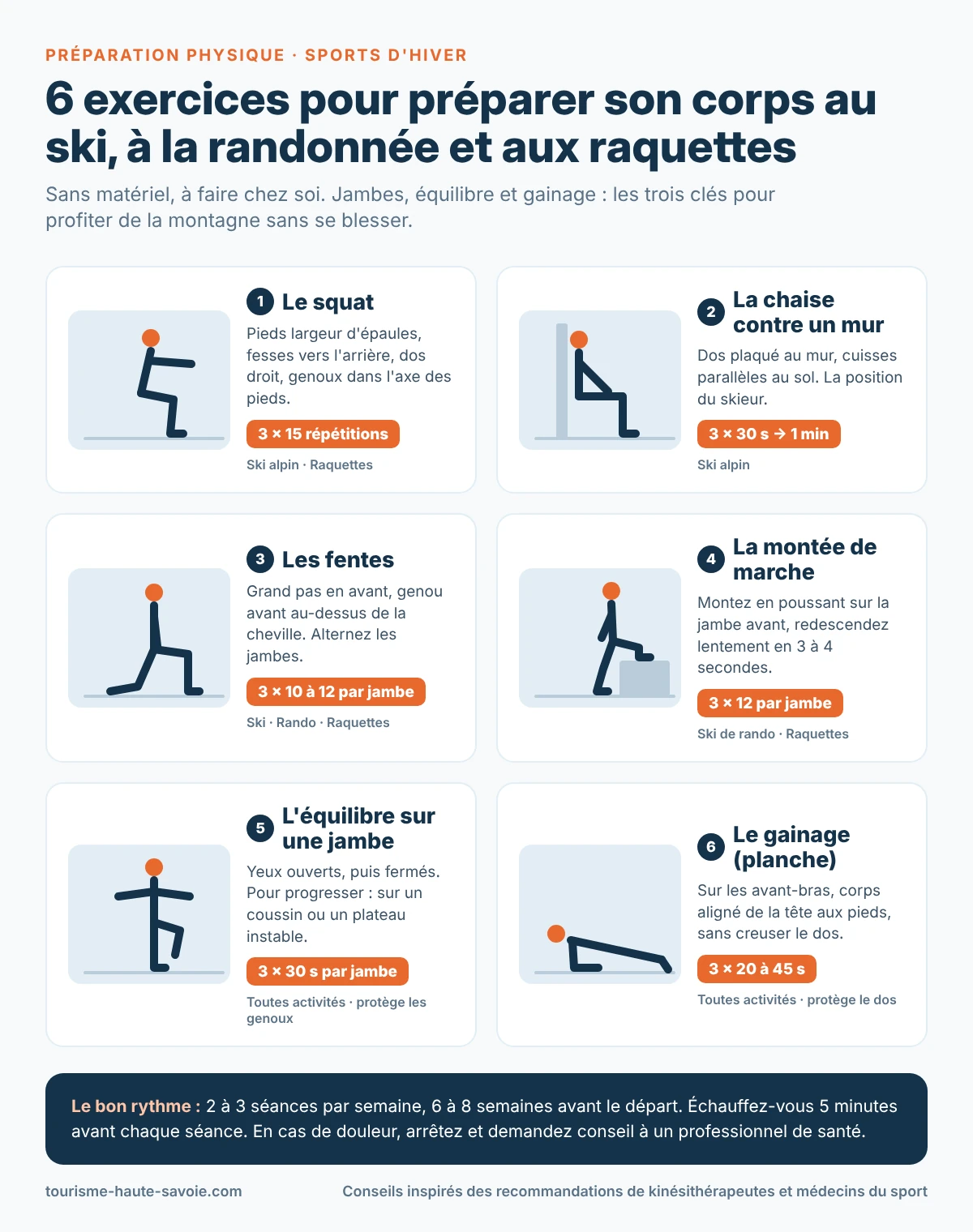
Strengthening your legs
Your thighs are the star muscles of winter sports. Work on them 2 to 3 times a week:
- Squats: stand with your feet shoulder-width apart and lower yourself as if sitting down, keeping your back straight. 3 sets of 15 reps.
- Wall sits: press your back against a wall, with your thighs parallel to the floor. Hold for 30 seconds to start, then gradually work up to 1 minute. This is the skier’s position.
- Forward, backward and lateral lunges: these work each leg separately and correct imbalances. 3 sets of 10 to 12 per leg.
- Step-ups: ideal preparation for hiking and snowshoeing.
Remember to include eccentric training
The physiotherapists at Les 3 Vallées emphasize eccentric training, which is when a muscle lengthens while controlling a movement, as it does on a descent. Running or walking downhill, slowly walking down stairs, or lowering into squats over 3 to 4 seconds directly prepares your thighs for long descents, on skis or snowshoes.
Core strength
A strong torso stabilizes your stance, protects your back and helps you maintain your balance when turning. Forearm planks, side planks and glute bridges: short, well-executed holds of 20 to 45 seconds are more effective than holding positions for a long time while arching your back.
Balance and proprioception
This is the most often overlooked area, and yet the one that best protects your knees. The principle recommended by FFS physiotherapists is to put your body slightly off balance to train your recovery reflexes.
- Stand on one leg, first with your eyes open and then with them closed.
- Do mini-squats on one leg.
- Use a balance cushion, wobble board or Bosu if you have one.
Cardio endurance
To last a full day on the slopes or manage a several-hour snowshoe climb, fitness matters as much as muscle strength. Running, cycling, brisk uphill walking or swimming, twice a week for 30 to 45 minutes. Trail running and mountain biking have an added benefit: they get your legs used to uneven terrain. However, the physiotherapists at Les 3 Vallées point out that swimming is less useful than weight-bearing activities for strengthening the legs.
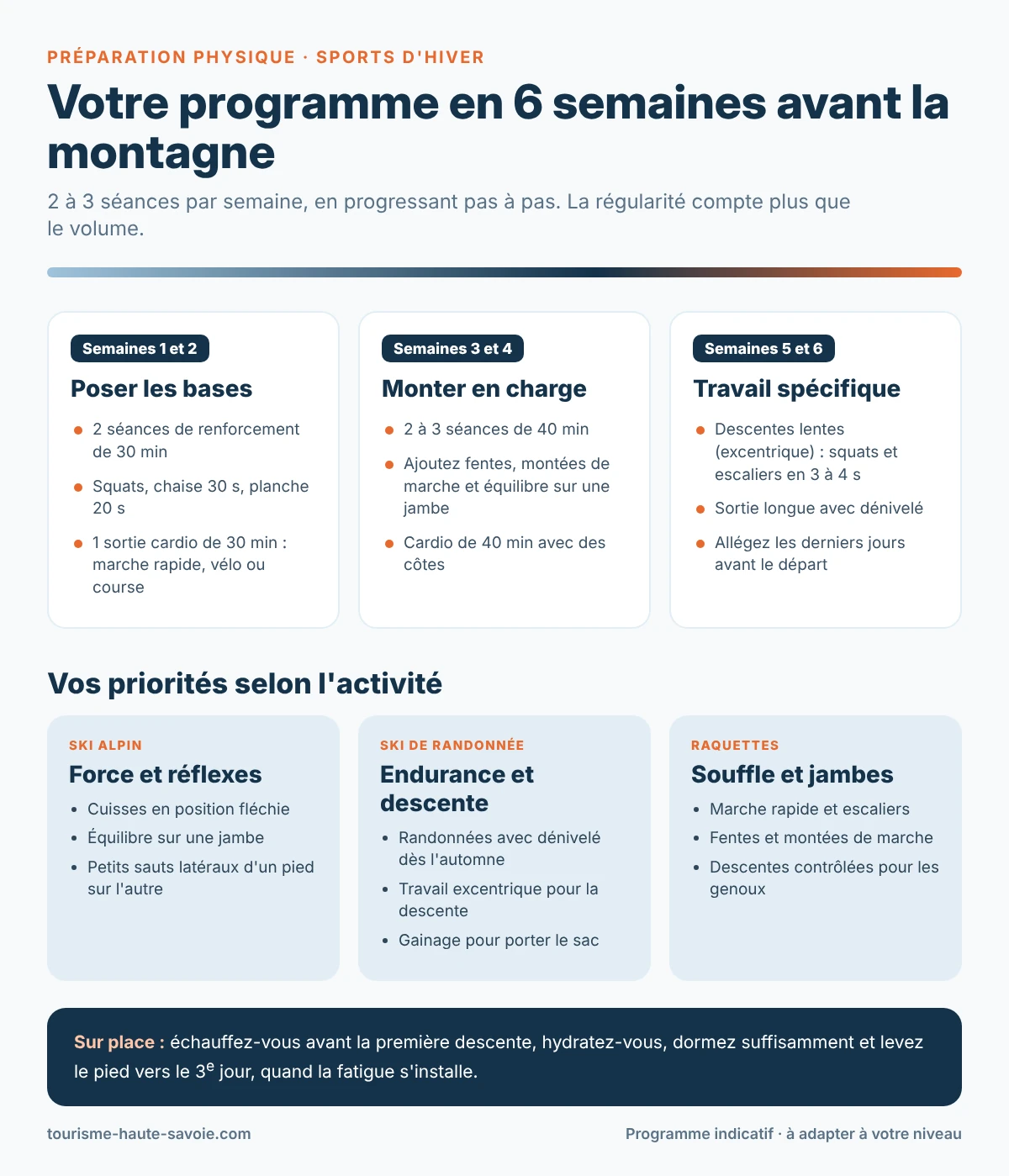
Specific advice for each activity
For downhill skiing
Focus on thigh strength in a bent position (wall sits, squats), balance and quick reactions. Add small side-to-side jumps from one foot to the other to practise changing your footing. And don’t forget your equipment: Dr Fayard points out that professionally adjusted bindings, equipment suited to your ability and slopes that match your level are all integral to injury prevention.
For ski touring
The effort is similar to a long uphill hike followed by a downhill ski run. So the main priority is to build endurance: go hiking on hilly trails in the autumn, cycle uphill and run. Beginners are strongly advised to go with a high-mountain guide or instructor, both to learn the technique and to stay safe in avalanche terrain.
Read also: Getting started with ski touring in Haute-Savoie: where, how and with whom?
For snowshoe hiking
Snowshoeing may seem accessible, but walking in the snow takes more energy than walking on a summer trail. Prepare with brisk walks, stair climbing and lunges. The French Hiking Federation also points out that a trip can take considerably longer than expected depending on snow conditions, that poles are essential, and that snowshoes are not suitable for steep slopes or hard snow. Off-piste, carrying a transceiver, shovel and probe is essential.
Practical examples: three typical profiles and how they can prepare
The examples below are typical profiles based on the recommendations of the professionals cited, to help you tailor your preparation.
Profile 1: the office worker going skiing for a week in February
In their forties and sedentary, they ski for one week a year. For them, 6 to 8 weeks of preparation is ideal: 2 strength-training sessions of 30 minutes per week (squats, wall sits, lunges, core exercises, single-leg balance) and one cardio session at the weekend. Once there, they avoid skiing all day on the first day and slow down around the third day, when fatigue starts to set in.
Profile 2: the summer hiker trying snowshoeing for the first time
Used to summer hikes, she already has a good fitness base. She keeps up her autumn walks, adding elevation gain, controlled descents and some balance exercises. For her first snowshoe outing, she chooses a marked route in settled snow and good weather, or goes with a mountain guide.
Profile 3: the athlete who wants to try ski touring
A regular runner, he has endurance but little strength for descents. His plan: eccentric thigh strengthening, core exercises and trail runs with downhill sections for 2 to 3 months. He books an introductory session with a guide to learn uphill technique and the basics of safety.
Once there: good habits to keep you going all week
- Warm up before your first run: spend a few minutes mobilizing your ankles, knees, hips and shoulders, then do some dynamic movements.
- Stay hydrated: cold weather and altitude can make you forget that you are thirsty.
- Eat a balanced diet: as Tanguy Asensio says, fondue should not become an everyday meal.
- Stretch gently in the evening and get enough sleep.
- Listen to your fatigue: the last run “for the road” at the end of the day is often the riskiest.
Read also: Ski holidays in Haute-Savoie: which resort to choose and how to plan your trip
FAQ: preparing your body for skiing, hiking and snowshoeing
How long before a ski trip should I start physical preparation?
Ideally, start 6 to 8 weeks before departure. If you are not very active, it is worth starting earlier, up to 2 or 3 months beforehand, so you can make progress gradually.
Which muscles should I work on before going skiing?
Prioritize your thighs (quadriceps), glutes and hamstrings, as well as your abdominal and back muscles through core exercises. You should also train your balance to protect your knees.
Can I prepare for skiing without equipment?
Yes: squats, wall sits, lunges, core exercises and single-leg exercises can all be done at home without equipment. A staircase is enough to practise climbing and descending.
Does snowshoeing require physical preparation?
Yes, because walking in the snow is more tiring than walking in summer. Work on your endurance (brisk walking, cycling), thighs and downhill strength, and adjust the length of your outings to the snow conditions.